

My Store
Design Technologies - Operation Airdrop: Lesson Plans (10 Lessons) + 1 Summative Assessment Task + FREE Student Design Portfolio Workbook (Year 5-6)
Design Technologies - Operation Airdrop: Lesson Plans (10 Lessons) + 1 Summative Assessment Task + FREE Student Design Portfolio Workbook (Year 5-6)
Couldn't load pickup availability
How do you combine Aerodynamics, Solar Energy and Humanitarian Aid into one high-flying project? Transform your Year 5 and 6 Design Technologies lessons with this mission-critical unit that challenges students to design drones for disaster relief!
Step into the mission control of "Operation Airdrop", a comprehensive Design Technologies unit designed to save you time and inspire the next generation of humanitarian engineers. This unit applies the Design Thinking process to a vital real-world challenge, blending the physics of "Flight and Circuits" with the empathy of "Disaster Relief," while connecting to essential lessons about material properties and systems.
Packed with "solar circuit workshops", "aerodynamic testing" with paper planes and "material stress tests," this unit will transform your classroom into an engineering hangar where students don't just build models, they engineer life-saving solutions as Aeronautical Engineers, Power Specialists and Logistics Managers.
What's Inside?
This comprehensive unit is meticulously planned to cover the Year 5 & 6 Design Technologies curriculum (specifically AC9TDE6K01 to AC9TDE6P05) with hands-on engagement. You will find:
- 10 Engaging Lesson Plans: Guide your "Air-Drop Squads" through the complete engineering mission. From investigating 'Natural Disasters' and defining 'Mission Constraints', to building 'Solar Circuits', understanding 'Aerodynamics', testing 'Material Properties' and constructing their own 'Aid-Delivery Drone'.
- Curriculum Aligned: This unit supports key learning objectives for Years 5-6. It covers Engineering Principles and Systems (energy transformation, forces), Materials and Technologies Specialisations and Technologies and Society (competing factors).
- Play-Based & Experiential Learning: Foster genuine understanding with interactive activities. Imagine your students conducting 'Paper Plane Experiments' to learn about lift and drag, building real 'Solar-Powered Motor Circuits', performing 'Strength-to-Weight' material tests and launching their prototypes in a 'Test Flight'.
- Built-in Assessment & Differentiation: Effortlessly monitor student progress. The unit includes formative tasks like the 'Mission Brief' and 'Electrical System Log' and summative tasks like the 'Final Design Portfolio'. It offers extension tasks for students to design 'Version 2.0 Proposals' or research composite materials.
- Real-World Skills: Help students connect tech theory to future careers. Activities encourage them to think like professionals, exploring roles like Humanitarian Engineers, UAV Pilots and Quality Assurance Analysts while balancing competing factors like speed, cost and safety.
Summative Assessment Task:
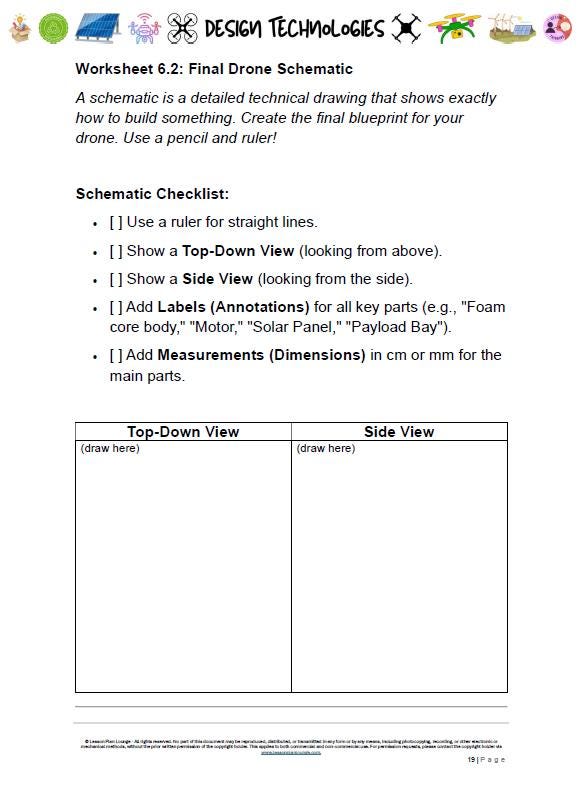
Conclude the unit with the "Operation Air-Drop Design Portfolio." In this comprehensive assessment, students compile their mission logs, schematics and material testing data, culminating in a "Test Flight Presentation" where they demonstrate their drone's functionality and reflect on its potential to assist in real-world humanitarian missions.
Cover Your Term of Design Tech!
This unit is designed to bridge the gap between technical physics concepts and social responsibility. Provide your students with high-quality, scaffolded lessons that turn abstract ideas about energy and flight into a tangible, solar-powered reality. Stop the endless search for engaging STEM resources and reclaim your time.
Download "Operation Airdrop" today and help your students engineer a better world!
Share