

My Store
Digital Technologies - Designing Our Digital Green Thumb: 10 Lesson Plans + 1 Summative Assessment and FREE Student WORKBOOK (Year 5 & 6)
Digital Technologies - Designing Our Digital Green Thumb: 10 Lesson Plans + 1 Summative Assessment and FREE Student WORKBOOK (Year 5 & 6)
Couldn't load pickup availability
How do you combine Coding, Data and Sustainability into one engaging project? Transform your Year 5 and 6 Digital Technologies lessons with this innovative unit that challenges students to design a "Smart Garden" system!
Step into the lab of "The Smart Garden Challenge," a comprehensive Digital Technologies unit designed to save you time and turn your students into agri-tech innovators. This unit applies Design Thinking to the real-world concept of automated gardening, blending the technical knowledge of "Digital Systems and Binary" with the creativity of "User Interface Design", while connecting to essential lessons about data privacy and environmental impact.
Packed with "device disassembly" labs, "human network" simulations and "visual coding" challenges, this unit will transform your classroom into a tech start-up where students don't just use devices, they engineer solutions as Systems Architects, UI Designers and Ethical Coders.
What's Inside?
This comprehensive unit is meticulously planned to cover the Year 5 & 6 Digital Technologies curriculum (specifically AC9TDI6K01 to AC9TDI6P10) with hands-on engagement. You will find:
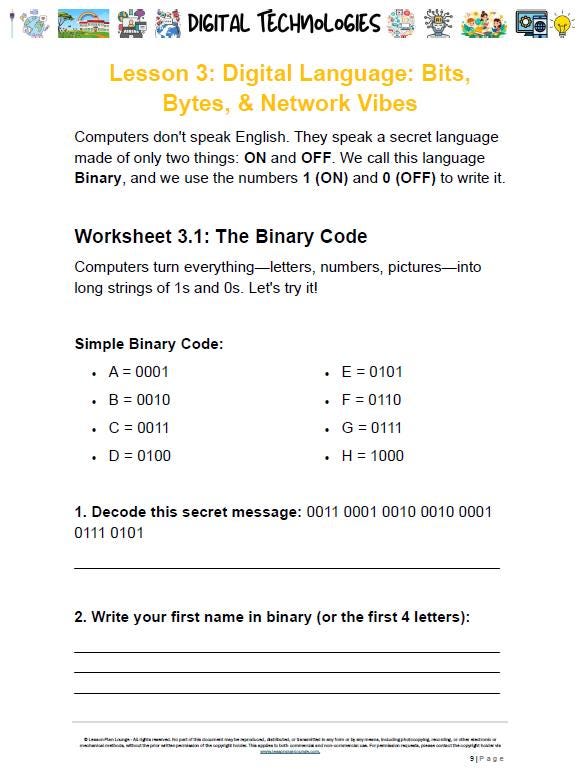
- 10 Engaging Lesson Plans: Guide your students through the full digital design process. From investigating 'Internal Components' (dissecting old tech) and decoding 'Binary' (the language of 0s and 1s), to defining 'User Stories', designing 'Algorithms' (flowcharts), creating 'User Interfaces' (UI) and 'Coding' a simulation of their smart system.
- Curriculum Aligned: This unit supports key learning objectives for Years 5-6. It covers Digital Systems (hardware/networks), Data Representation (binary), Specification, Algorithms and Implementation (coding) and Digital Citizenship (privacy/footprint).
- Play-Based & Experiential Learning: Foster genuine understanding with interactive activities. Imagine your students performing a 'Human Network Simulation' with string to understand data transmission, playing 'Binary Decoder' games with cards, sketching 'UI Layouts' for a garden app and building a 'Scratch Simulation' to water plants automatically.
- Built-in Assessment & Differentiation: Effortlessly monitor student progress. The unit includes formative tasks like the 'Parts of a Digital System' worksheet and 'Algorithm Flowcharts' and summative tasks like the 'Smart Garden Expo'. It offers extension tasks for students to research 'Advanced Sensors' or explore 'Cybersecurity'.
- Real-World Skills: Help students connect tech theory to future careers. Activities encourage them to think like professionals, exploring roles like Software Developers, UX Designers and Network Engineers while considering the ethical impact of collecting user data.
Summative Assessment Task:
Conclude the unit with the "Smart Garden Expo." In this capstone project, students present their complete digital solution to the class. They showcase their User Interface designs, explain their Algorithms and Data Representation, demonstrate their Coded Simulation and reflect on the Ethical Impacts (privacy and digital footprint) of their system.
Cover Your Term of Digital Tech!
This unit is designed to bridge the gap between abstract computer science concepts and tangible real-world application. Provide your students with high-quality, scaffolded lessons that turn complex topics like binary and branching algorithms into accessible, fun learning experiences. Stop the endless search for engaging STEM resources and reclaim your time.
Download "The Smart Garden Challenge" today and help your students grow their digital skills!
Share