
Lesson Plan Lounge
FREE DOWNLOAD - The Lead Magnet - The Regulation Station Essentials Checklist - Primary Education
FREE DOWNLOAD - The Lead Magnet - The Regulation Station Essentials Checklist - Primary Education
Couldn't load pickup availability
From Compliance to Connection: A Practical Guide to Building a Self-Regulation Sanctuary.
Tired of the "behaviour management" battle? It’s time to stop managing compliance and start teaching regulation.
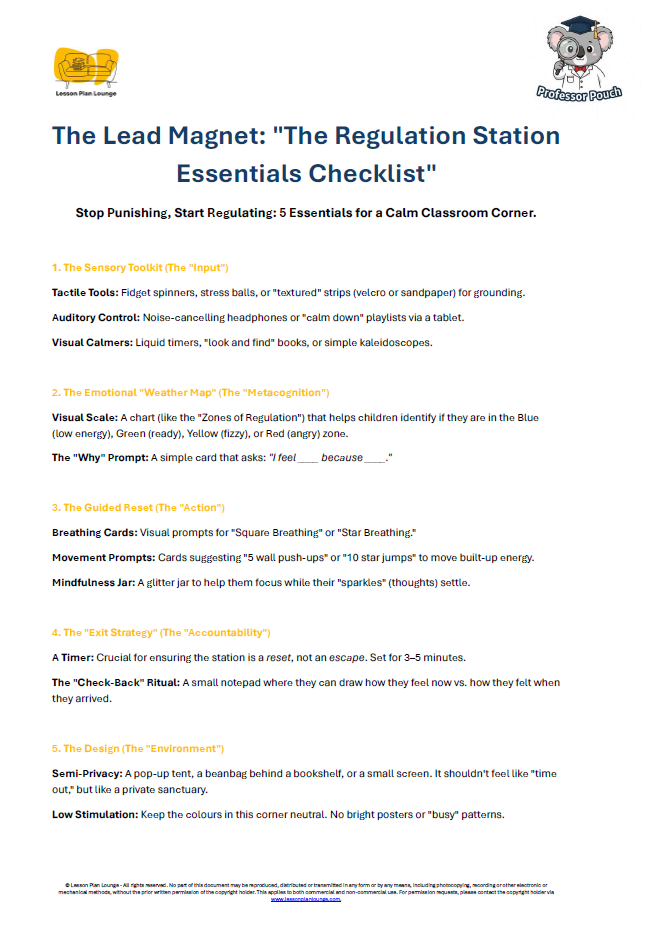
The Regulation Station Essentials Checklist is a research-backed, classroom-ready guide designed to help Primary educators move away from outdated "public shame" charts and toward a neuro-affirming, trauma-informed classroom environment. Whether you are a Year 1 teacher dealing with "the fizzes" or a Year 6 teacher looking to support executive function, this checklist provides the exact blueprint for a space that actually works.
What’s Inside?
This comprehensive 1-page PDF guide breaks down the five pillars of a successful calm-down corner:
- The Sensory Toolkit: How to select tactile, auditory, and visual tools that ground students without overstimulating them.
- Metacognition Maps: Strategies to help students identify their "emotional weather" and take ownership of their needs.
- The Action Reset: Clear, visual prompts for breathing and movement that shift the nervous system out of "fight or flight".
- Accountability & Flow: Practical tips on using timers and "check-back" rituals to ensure the station is a tool for learning, not just an escape.
- AESTHETIC & Layout: Tips for designing a semi-private, low-stimulus space that blends seamlessly into your classroom.
Why You Need This
- Neuro-Affirming: Perfect for supporting ADHD, Autistic, and trauma-impacted students.
- AISTL Aligned: Directly supports Standard 4: Create and maintain supportive and safe learning environments.
- Psychology-Backed: Built on the principles of cognitive load theory and nervous system regulation.
The Call to Action (CTA)
[Download Now for Free] Join 5,000+ Aussie educators who are retiring the "Wall of Shame" and building classrooms where every child feels safe to learn.
Share